

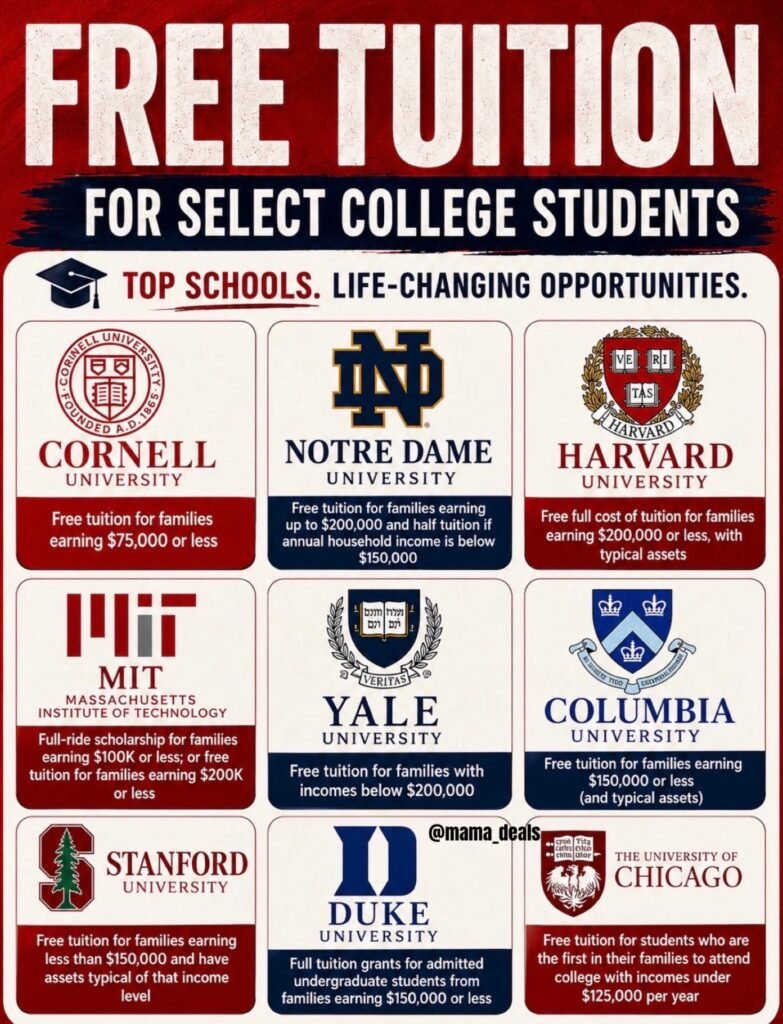
College costs can feel overwhelming, but many families are surprised to learn that some of the nation’s top universities now offer tuition-free opportunities for qualifying students. In many cases, families earning well into the six figures may still qualify for significant financial aid.
Requirements vary by school and can depend on family income, assets, residency, FAFSA information, and financial aid guidelines.
College: Offer Details
Cornell University: Families earning approximately $75,000 or less may qualify for free tuition and significant financial aid assistance.
University of Notre Dame: Families earning up to $200,000 may qualify for free tuition, while some households earning under $100,000 may receive additional support.
Harvard University: Families earning up to $200,000 annually may qualify for free tuition. Families with lower incomes may also qualify for additional support covering housing, meals, and other expenses.
MIT (Massachusetts Institute of Technology): Families earning under $200,000 may qualify for tuition-free education, while lower-income families may receive full cost assistance.
Yale University: Yale offers generous need-based aid programs that can significantly reduce or eliminate tuition costs for qualifying families.
Columbia University: Families earning less than $150,000 with typical assets may qualify for tuition assistance or free tuition programs.
Stanford University: Families earning under $150,000 with typical assets may qualify for free tuition. Families with lower incomes may receive additional help with room and board.
Duke University: Admitted undergraduate students from qualifying households may receive tuition grants and financial aid assistance.
University of Chicago: First-generation students from qualifying families may qualify for tuition assistance programs.
University of Pennsylvania (Penn): Penn offers generous need-based financial aid programs and many families earning within qualifying income ranges may receive significant tuition assistance.
Princeton University: Princeton provides one of the nation’s largest financial aid programs and many students graduate debt-free through grants rather than loans.
Dartmouth College: Dartmouth offers expanded financial aid opportunities and tuition assistance for qualifying families.
Brown University: Brown offers need-based financial aid and expanded support for qualifying students and families.
Johns Hopkins University: Johns Hopkins recently expanded financial aid eligibility for middle-income families.
University of Virginia: Students from qualifying Virginia families may be eligible for tuition assistance programs.
University of North Carolina at Chapel Hill: UNC offers programs designed to help qualifying students reduce tuition costs.
Rice University: Rice has expanded its aid program and offers substantial tuition assistance opportunities for qualifying families.
Things Parents Should Know
- Income limits vary by school
- Assets can affect eligibility
- FAFSA and CSS Profile forms may be required
- Some schools may also cover housing, meals, books, and fees
- Financial aid programs can change yearly
- Additional scholarships may be available
Many parents assume elite colleges are completely out of reach because of the high sticker price, but after grants and financial aid, some private schools may actually cost less than a state university.
Frequently Asked Questions
Do these colleges automatically give free tuition?
No. Eligibility often depends on household income, assets, FAFSA information, CSS Profile forms, and other financial factors.
Can middle-income families qualify?
Yes. Several schools now extend assistance to families earning well into six figures.
Can colleges also cover housing and meals?
Some schools may also help with room and board, books, and other educational expenses depending on financial need.
Do I need to complete FAFSA?
Most schools require FAFSA and may also require additional financial aid forms.










6 Comments
There’s anything options for F1 students?
F-1 international students may still qualify for some tuition-free or heavily discounted programs, but many of the free tuition programs listed are limited to U.S. citizens, permanent residents, or students eligible for federal financial aid. F-1 students should look for colleges that offer institutional scholarships, need-based aid for international students, or special international student grants.
Does UConn have this option as well?
UConn previously announced the Connecticut Commitment program, which offered free tuition for some low-income Connecticut students, but the program was later paused. UConn still offers scholarships, grants, and financial aid opportunities, so it’s worth checking with UConn Admissions or Financial Aid for the latest options.
This is typically for students who are independent or dependent?
It depends on the school and program. Some free tuition programs are available to dependent students based on their parents’ income, while others are open to independent students based on their own income. Each college sets its own eligibility requirements, so it’s important to check the specific program details.